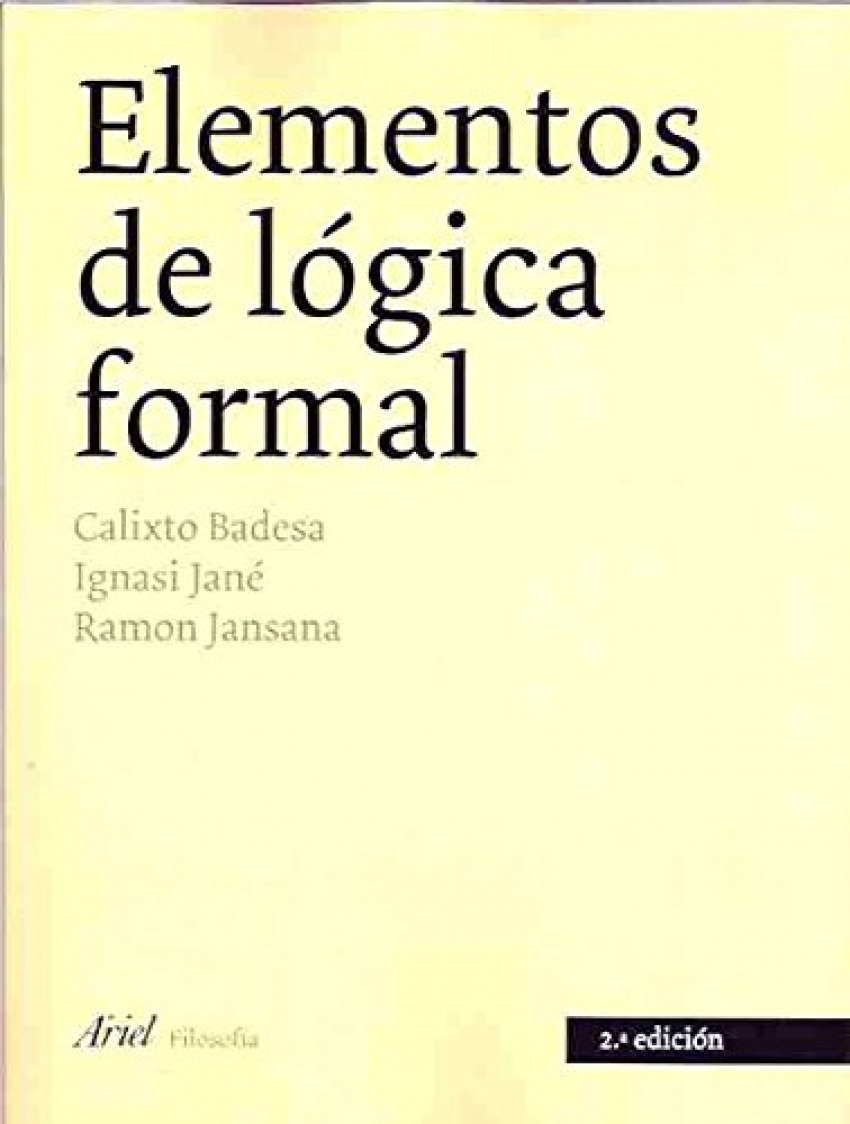
https://devlaravel.imosver.com/en/libros/elementos-de-logica-formal-00100767920010076792Elementos de lógica formal27.55La Filosofía se ha interesado prácticamente desde sus orígenes por los aspectos formales del razonamiento. Aristóteles fue el primero en desarrollar una teoría de la argumentación deductiva, por lo quhttps://static.arnoia.com/imagenes_small/9788434/978843448777.jpgLibrosLibros/FILOSOFIASin stockARIEL000https://static.arnoia.com/imagenes_small/9788434/978843448777.jpg2951.451998/09/019788434487772Badesa / Jane / JansanaLibrosaño_1998idioma_SpanishCformato_Tapa blanda o Bolsilloautor_Badesa / Jane / Jansanasaga_FILOSOFIA
Artículo
Elementos de lógica forma
Badesa / Jane / Jansana
ARIEL
FILOSOFIA
? Cookie Notice
We use cookies to ensure you get the best experience on our website.
Read cookie policy.
? Manage cookie preferences
This type of cookie allows the user to browse a website, platform, or application and to use the different options or services that exist on it.
imosver_session
Description
Essential first-party cookie. It keeps your session identified while you browse: your basket, your language and access to your account. The website cannot work without it.
Duration
120 minutes
Dependencies
Domain
imosver.com
OCT8NE
Description
This cookie is used for the proper functioning of the Oct8ne Chat to provide customer support service to the user.
These are those that enable the tracking and analysis of user behavior on our website. The information collected is used to measure user activity on the website and to create user browsing profiles.
_clsk
Description
It records statistical data about the visitor's behavior on the website. This is used for internal analysis by the website operator.
Duration
1 days
Dependencies
Domain
imosver.com
logglytrackingsession
Description
Identifies and records the user session for analytical purposes.
Duration
Session
Dependencies
Domain
.imosver.com
GOOGLE_ANALYTICS
Description
Records a unique identifier that is used to generate statistical data about how the visitor uses the website.
Duration
1 year
Dependencies
Domain
.imosver.com
_clck
Description
Microsoft Clarity first-party cookie. It stores an anonymous browser identifier so that visits to this website can be attributed to the same user and usage statistics can be produced.
Duration
1 year
Dependencies
Domain
imosver.com
CLID
Description
Microsoft Clarity third-party cookie. It identifies the first time Clarity detects this browser on any website using the service.
Duration
1 year
Dependencies
Domain
clarity.ms
_ga
Description
Google Analytics cookie. It stores an anonymous browser identifier in order to distinguish users and produce website usage statistics.
Duration
2 year
Dependencies
Domain
.imosver.com
_ga_LZR660YW0M
Description
Google Analytics 4 cookie. It keeps the analytics session state so that visits and the journey through the website can be measured.
Duration
2 year
Dependencies
Domain
.imosver.com
These are the ones that allow us to adapt the navigation on our website to your preferences (e.g., language, browser used, etc.).
_fbp
Description
Used by Facebook to offer a series of advertising products, such as real-time bids from third-party advertisers.
Duration
3 month
Dependencies
Domain
.imosver.com
afiliado
Description
First-party affiliate programme cookie. It stores for 30 days the code of the affiliate that brought you to the website, so that the sale can be attributed to them.
Duration
1 month
Dependencies
Domain
imosver.com
MUID
Description
Microsoft third-party cookie. It identifies unique browsers visiting Microsoft sites and is used for advertising, analytics and other operational purposes.
Duration
1 year
Dependencies
Domain
clarity.ms
ANONCHK
Description
Microsoft third-party cookie. It indicates whether the MUID identifier is transferred to ANID, a cookie used for advertising purposes.
Duration
10 minutes
Dependencies
Domain
clarity.ms
MR
Description
Microsoft third-party cookie. It indicates whether the MUID identifier must be refreshed.
Duration
7 days
Dependencies
Domain
clarity.ms
SM
Description
Microsoft third-party cookie. It synchronises the MUID identifier across Microsoft domains.
Duration
Session
Dependencies
Domain
clarity.ms
_fbc
Description
Meta cookie. It stores the identifier of the Facebook or Instagram advert you arrived from, in order to attribute the visit to that advertising campaign.
Duration
3 month
Dependencies
Domain
.imosver.com
_gcl_au
Description
Google Ads cookie. It records a visit coming from an advert so that advertising campaign conversions can be measured.
Duration
3 month
Dependencies
Domain
.imosver.com
_uetsid
Description
Microsoft Advertising cookie. It identifies your browsing session in order to measure conversions from Bing advertising campaigns.
Duration
1 days
Dependencies
Domain
.imosver.com
_uetvid
Description
Microsoft Advertising cookie. It identifies your browser across visits in order to measure conversions from Bing advertising campaigns.
La Filosofía se ha interesado prácticamente desde sus orígenes por los aspectos formales del razonamiento. Aristóteles fue el primero en desarrollar una teoría de la argumentación deductiva, por lo que se le considera con justicia el creador de la lógica como disciplina. La lógica permaneció esencialmente en el mismo estado en que la dejó Aristóteles hasta mediados del siglo xix, cuando inició un nuevo desarrollo, basado en gran medida en su capacidad para analizar con ayuda de métodos matemáticos formas de razonamiento de las que la lógica aristotélica no podía dar cuenta, en particular, aquellas en que intervienen expresiones cuantificacionales múltiples y expresiones relacionales. Para el tratamiento sistemático de estas formas de razonamiento, se desarrollaron a finales del siglo xix y principios del xx la teoría de las relaciones y la de la cuantificación. Estas dos teorías, junto con el cálculo proposicional, cuyo estudio iniciaron los lógicos megáricos y estoicos, constituyen el cuerpo básico de conocimientos de la lógica, una disciplina que a lo largo del siglo xx se ha desarrollado considerablemente y que está todavía en expansión. Elementos de lógica formal es un manual de introducción a la lógica, escrito especialmente para estudiantes de filosofía, pero también para aquellas personas con formación humanística interesadas en materias que requieran conocimientos lógicos. En él se exponen los conceptos y resultados básicos de la lógica contemporánea sin presuponer ningún conocimiento técnico especial por parte del lector. Los elementos de teoría de conjuntos necesarios para presentar con rigor la lógica proposicional y, sobre todo, la cuantificacional se introducen de forma pausada en los primeros capítulos del libro. El concepto de infinitud, que tradicionalmente ha sido objeto de reflexión filosófica, es un concepto propio de la teoría de conjuntos que el lector también encontrará caracterizado con rigor en estos capítulos.